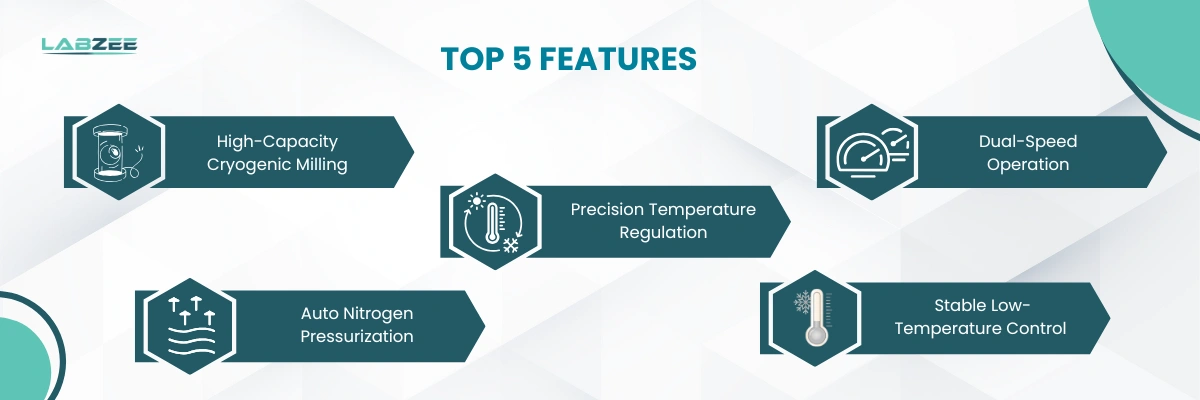
Liquid Nitrogen Planetary Ball Mill BZLNB-503 is a robust cryogenic milling system engineered for heavy-duty laboratory applications and advanced material research. This ball mill accommodates grinding jar and vacuum jar sizes ranging from 500–2000 ml, and enables precise temperature control from -60°C to -1°C, making it ideal for processing volatile, elastic, or heat-sensitive samples. It offers efficient rotational dynamics through adjustable sun wheel and jar speeds for consistent milling output. Its automatic 50L nitrogen pressurization system ensures long-duration, ultra-low temperature operation. Our Liquid Nitrogen Planetary Ball Mill BZLNB-503 is extensively used in fields like polymer science, nanotechnology, pharmaceuticals, chemical analysis, and materials research requiring cryogenic sample integrity.
| Grinding Jar Size | 500-2000 ml |
| Vacuum Jar Size | 500-2000 ml |
| Sun Wheel Speed | 5-320 rpm |
| Ball Mill Jar Speed | 10-640 rpm |
| Control Temperature | -60°C to -1°C |
| Nitrogen Canister | Auto pressurization 50L |
| Power Consumption | 1.5 kW |
| Power Supply | 220V/380V/50Hz |
| Product Dimension | 83×57×72 cm |
| Net Weight | 128 kg |
Our Liquid Nitrogen Planetary Ball Mill BZLNB-503 is suited for advanced cryogenic applications involving polymers, nanocomposites, biological samples, elastomers, pharmaceuticals, and other heat-sensitive substances. It delivers high efficiency grinding while preserving material structure under sub-zero temperatures.
Frequently Asked Questions
1: How is the grinding efficiency compared to regular planetary ball mills?
The cryogenic environment improves grinding efficiency, especially for materials that would otherwise become sticky or rubbery from heat. It helps produce more uniform, finer particles.
2: Can you process biological samples in this mill?
Yes, biological tissues, cells, and other organic samples can be processed in this mill. Cryogenic grinding helps preserve DNA, proteins, and enzymes during homogenization.
3: What capacity options are available for grinding jars?
Grinding jars come in various sizes ranging from a few milliliters to several hundred milliliters, allowing flexibility depending on the amount of sample you need to process.
4: How does the machine prevent overheating of samples?
The use of liquid nitrogen continuously absorbs heat generated during grinding, keeping the sample at low temperatures and preventing thermal damage.
5: Can you adjust the grinding direction in this equipment?
Yes, most models offer the ability to reverse or alternate the grinding direction, enhancing mixing and preventing sample sticking or uneven grinding.
6: Can you explain what a Liquid Nitrogen Planetary Ball Mill is used for?
A Liquid Nitrogen Planetary Ball Mill is a high-energy milling device used to grind, mix, or homogenize materials at cryogenic temperatures. By incorporating liquid nitrogen, it allows the processing of heat-sensitive or soft materials without degradation or loss of volatile components.
7: How does the use of liquid nitrogen benefit the planetary ball milling process?
Using liquid nitrogen lowers the temperature inside the mill chamber significantly, which prevents overheating of the material. This is especially useful when working with polymers, pharmaceuticals, or other materials that degrade or melt under frictional heat.
8: Can you operate the Liquid Nitrogen Planetary Ball Mill for long durations?
Yes, this ball mill is designed for extended use, with insulated systems that maintain cryogenic temperatures and durable components that withstand continuous operation. However, refilling of liquid nitrogen and periodic maintenance are required for optimal performance.
9: What types of materials can you process in a Liquid Nitrogen Planetary Ball Mill?
This mill is suitable for brittle, elastic, fibrous, or temperature-sensitive materials. It is commonly used for biological samples, pharmaceuticals, plastics, resins, metals, and advanced ceramics.
10: Can you achieve nanoscale particle sizes with this mill?
Yes, the Liquid Nitrogen Planetary Ball Mill is capable of achieving ultrafine and even nanoscale particle sizes. The powerful grinding action, combined with cryogenic cooling, helps produce highly uniform and fine particles.