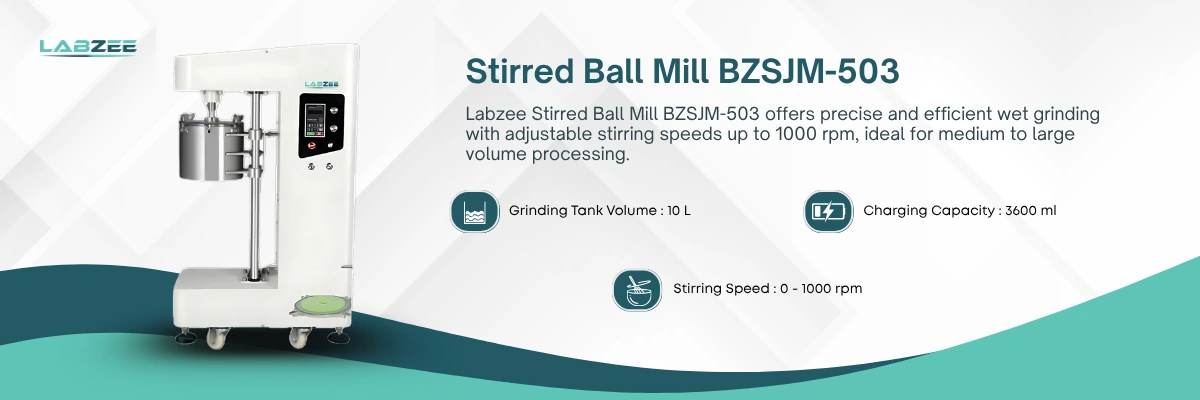
Labzee Stirred Ball Mill BZSJM-503 offers precise and efficient wet grinding with adjustable stirring speeds up to 1000 rpm, ideal for medium to large volume processing. It features a generous 10 L grinding tank and a 3600 ml charging capacity, ensuring thorough and uniform dispersion. This system provides uniform milling of thermally sensitive materials through integrated water cooling. Its compact design allows easy placement and operation in limited lab spaces. Our Stirred Ball Mill BZSJM-503 is perfect for battery slurries, ceramic dispersion, polymer emulsions, magnetic mixing, and pharmaceutical processing.
| Grinding Tank Volume | 10 L |
| Charging Capacity | 3600 ml |
| Stirring Speed | 0 - 1000 rpm |
| Power Consumption | 3000 W |
| Power Supply | AC 380V, 50Hz |
| Cooling Method | Water cooling cycle |
| Product Dimension | 78 ×55 ×132 cm |
| Net Weight | 160 Kg |
| Gross Weight | 203 Kg |
Our Stirred Ball Mill BZSJM-503 is widely used in polymer matrix development, electrode paste homogenization, advanced ceramics processing, nanomaterial emulsification, and pigment slurry blending.
Frequently Asked Questions
1: How fine can you grind materials in this mill?
You can achieve particle sizes below 1 micron in many cases. With proper media and speed, even nano-sized particles are possible. It's ideal for industries needing extreme fineness. Stirred ball mills are very energy efficient for this.
2: What’s the energy consumption like?
Stirred ball mills are energy-efficient compared to traditional mills. The focused agitation requires less power to achieve fine results. You get better results with lower power input. They’re great for continuous, cost-effective grinding.
3: Does the mill vibrate a lot?
No, stirred ball mills produce very low vibration. They use internal agitation, not impact forces. This makes them quieter and safer in the lab. Minimal vibration also reduces wear on other parts.
4: Is it suitable for continuous operation?
Yes, some stirred mills are designed for continuous processing. You can feed materials and remove output simultaneously. It's helpful for industrial or pilot-scale work. Just ensure your setup handles flow and cooling.
5: What is the recommended load capacity?
It varies by model, but you typically fill 60–80% of the chamber with media and slurry. Overloading reduces efficiency and causes wear. Underloading wastes energy and reduces grinding impact. Always follow the user manual.
6: What is a stirred ball mill used for?
A stirred ball mill is used for ultra-fine grinding and dispersion of solids in liquids. You can use it in industries like pharmaceuticals, ceramics, and chemicals. The stirring action creates high energy for fine grinding. It's ideal when particle size reduction is essential.
7: How does a stirred ball mill work?
It uses a motor-driven agitator to stir grinding media and the material inside the chamber. The intense motion breaks particles down efficiently. You can control the speed and duration for better results. This continuous mixing gives uniform grinding.
8: What makes it different from other ball mills?
Stirred ball mills work at lower speeds but use high-shear energy. You get better energy efficiency compared to traditional mills. The media moves continuously due to the agitator. It’s better suited for very fine or nano-scale grinding.
9: What materials can you grind in it?
You can grind ceramics, pigments, pharmaceutical powders, metal oxides, and polymers. It handles both hard and soft materials well. The machine is highly adaptable to different sample types. Just make sure your media is compatible.
10: Is the stirred ball mill suitable for wet grinding?
Yes, it is primarily designed for wet grinding. You can use water, alcohol, or other solvents as the medium. This helps reduce heat buildup and improves grinding efficiency. It’s great for suspension and slurry processing.