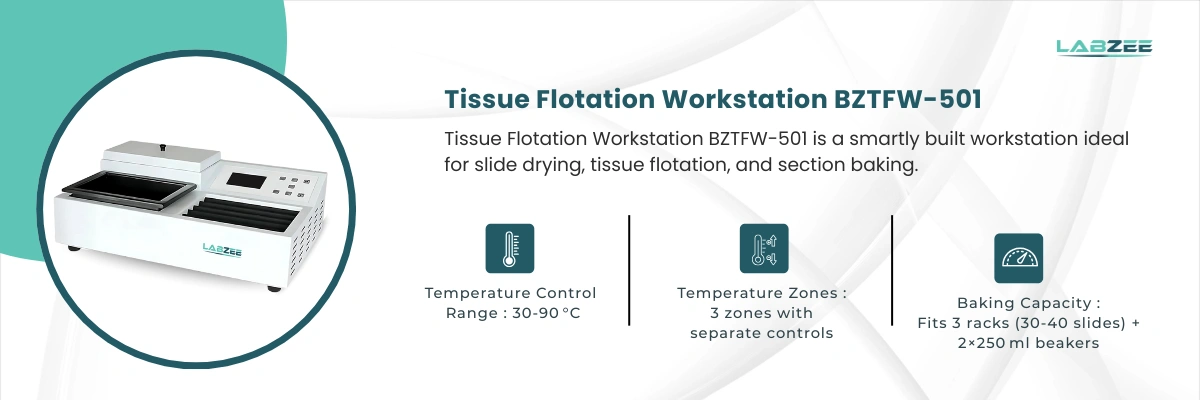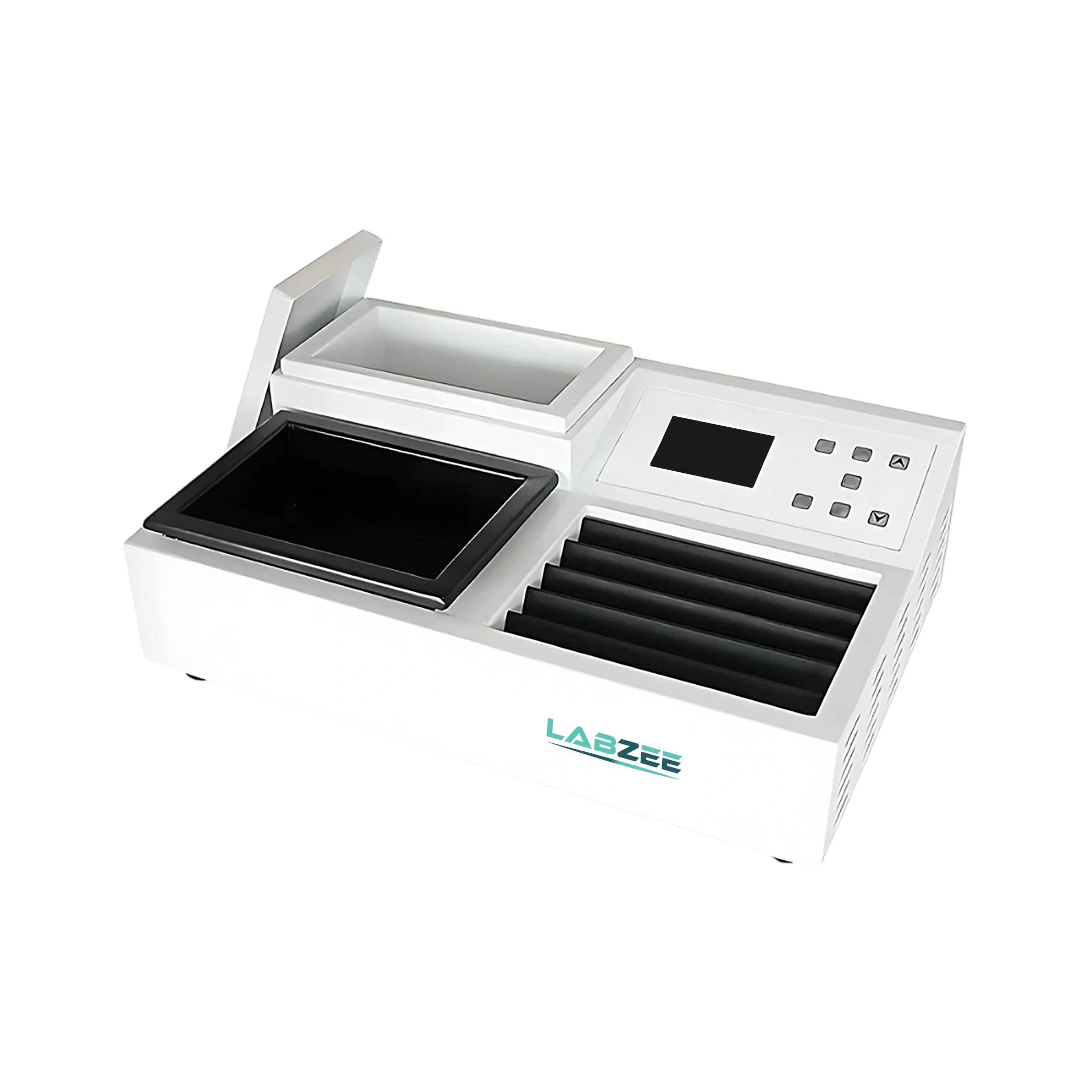
Tissue Flotation Workstation BZTFW-501 is a smartly built workstation ideal for slide drying, tissue flotation, and section baking. This tissue processor offers a temperature control range of 30–90 °C, three independently controlled temperature zones, and accommodates up to 40 slides and two 250 ml beakers. It combines ergonomic design with specialized black enamel polymer tanks that promote efficient thermal conductivity and user comfort. It enables streamlined processing with precise thermal balance across multiple zones. Our Tissue Flotation Workstation BZTFW-501 is perfect for pathology labs, histology centers, university labs, and research clinics.
| Temperature Control Range | 30-90 °C |
| Temperature Control | Automatic Constant Temperature |
| Temperature Zones | 3 zones with separate controls |
| Baking Capacity | Fits 3 racks (30-40 slides) + 2×250 ml beakers |
| Slide Holding Capacity | 60° angle slot, holds 40 slides |
| Tank Material | Black enamel polymer |
| Water Bath Dimension | 190 × 140 × 70 mm |
| Product Dimension | 510 × 340 × 220 mm |
| Package Dimension | 550 × 340 × 220 mm |
| Net Weight | 11 Kg |
| Gross Weight | 13.5 Kg |
| Package Type | Wooden Case |
Our Tissue Flotation Workstation BZTFW-501 is used in pathology and histopathology labs to aid in slide drying and floating tissue sections prior to staining. With the ability to hold multiple slides and containers at once, it supports high-throughput workflows with precision. Its triple-zone heating system makes it suitable for labs that require customized and consistent slide preparation across different temperature ranges.
Frequently Asked Questions
1: What is the temperature control range for the Tissue Flotation Workstation BZTFW-501?
The Tissue Flotation Workstation BZTFW-501 allows for temperature control between 30?°C and 90?°C. This wide range supports various slide preparation techniques, including tissue flotation and drying.
2: How many slides can it hold at once?
This model is capable of holding up to 40 slides in a 60° angled slot. This design ensures proper drainage and drying during and after the flotation process.
3: What makes this workstation different from traditional slide warmers?
The BZTFW-501 features three separate temperature zones, each with individual control, allowing users to manage distinct slide preparation processes simultaneously. It also includes dedicated space for two 250?ml beakers.
4: Is the tank material durable and lab-safe?
Yes, the tank is made from black enamel polymer, known for its durability and heat retention. It’s designed for safe contact with lab tools and samples, ensuring no interference with sensitive slides.
5: Where is the Tissue Flotation Workstation BZTFW-501 commonly used?
This unit is widely used in histology labs, clinical research centers, university pathology departments, and diagnostic laboratories for its ability to support multiple slide preparation activities in one compact workstation.
6: When is a Tissue Flotation Workstation preferred over separate equipment?
It is preferred when space-saving, speed, and workflow efficiency are priorities. Combining the bath and paraffin dispenser reduces handling and contamination. It is ideal for high-throughput labs with limited bench space.
7: Can both components be controlled independently?
Yes, most models offer separate temperature controls for the dispenser and water bath. This allows flexibility in managing optimal conditions for both functions. Independent operation ensures process precision.
8: Can it accommodate multiple users during peak lab hours?
Yes, the workstation design allows multiple sections to be processed sequentially. Its spacious bath and accessible dispenser enable efficient teamwork. Larger models support even greater throughput.
9: When should routine maintenance be performed?
Basic cleaning should be done daily, with a full check weekly. Remove wax residues and replace water regularly to maintain hygiene. Proper care ensures consistent performance and longer service life.
10: Can it be used for all types of paraffin blocks and section thicknesses?
Yes, it supports various block sizes and typical section thicknesses used in histology. Its temperature control ensures flexibility for different embedding media. Always follow manufacturer recommendations for best results.