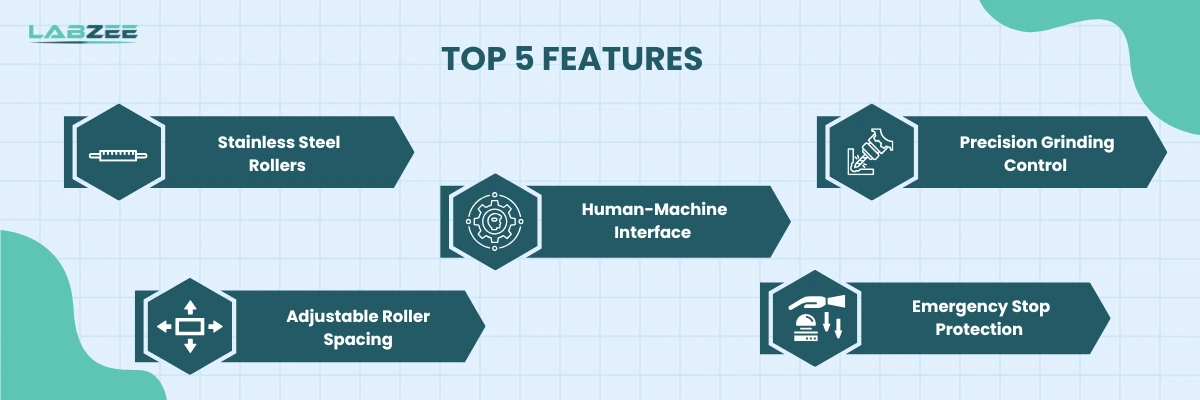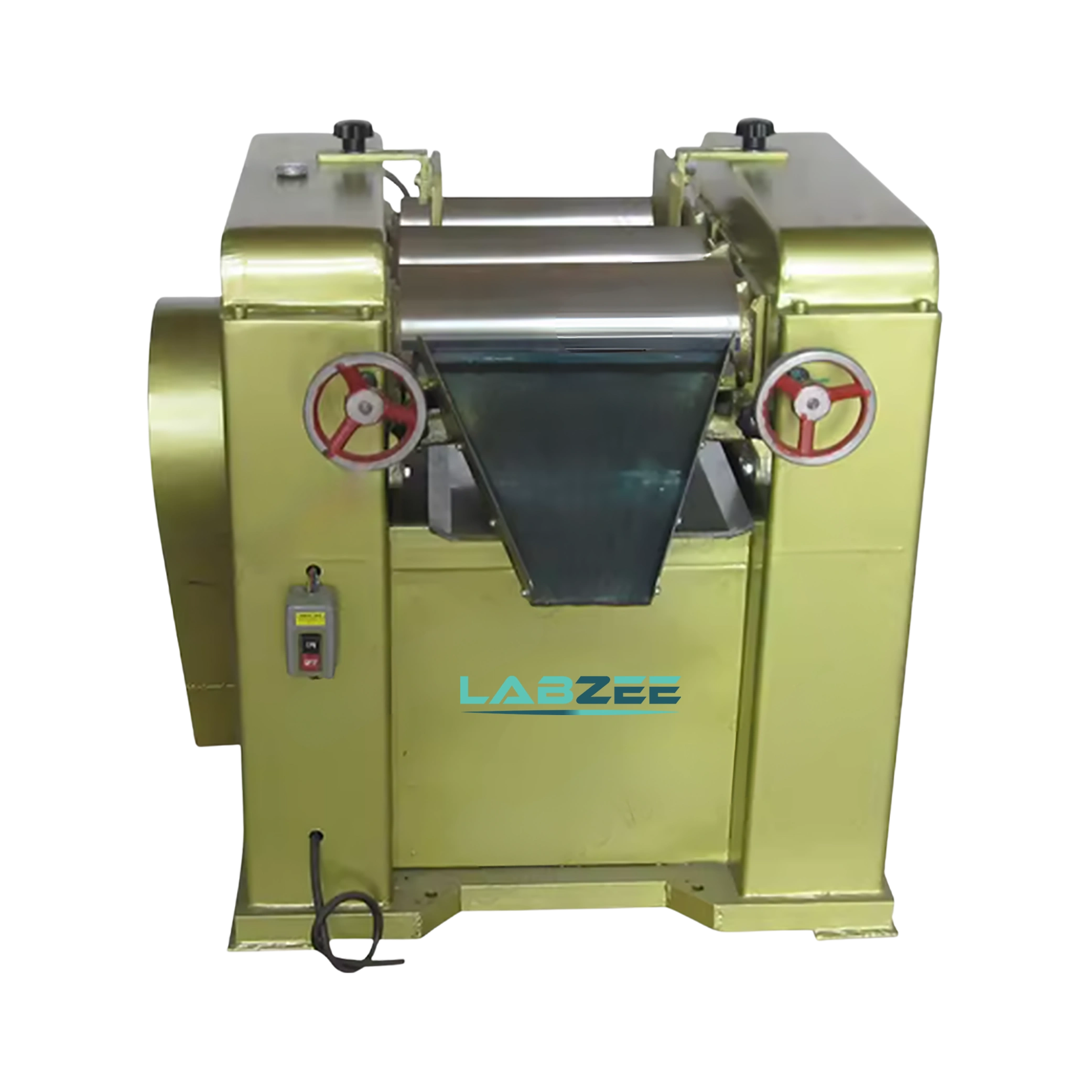
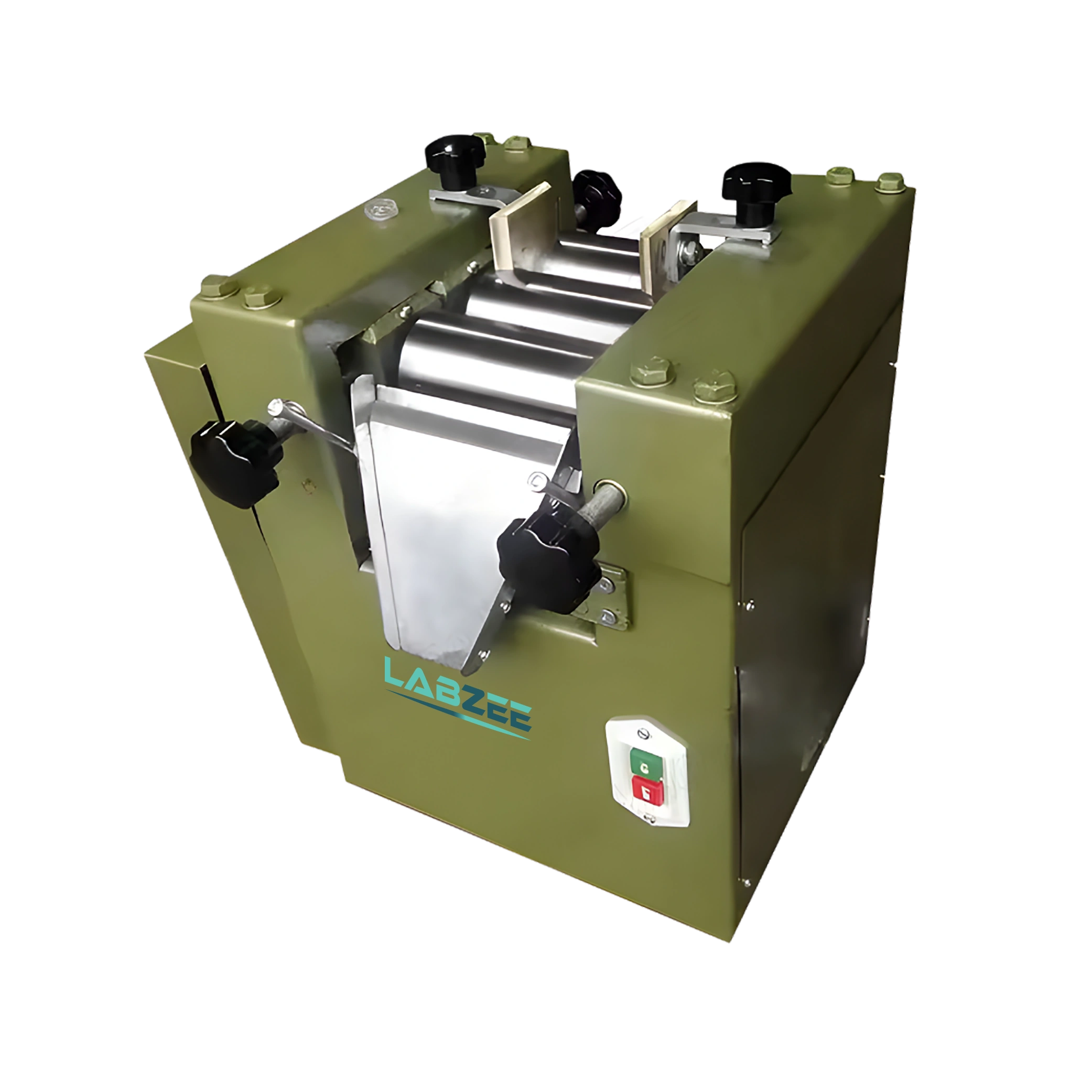
Triple Roller Mill BZTRM-502 is designed to achieve ultra-fine dispersion and grinding of high-viscosity materials in laboratory and small-scale production settings. This precision-engineered mill uses high-quality stainless-steel rollers and allows fine spacing adjustment via handwheel control to ensure uniform particle processing. With a roller precision of ≤2μm and rotational speed designed for efficient shearing, it guarantees consistent output and excellent product texture. Its compact structure, integrated control interface, and emergency protection system make it suitable for demanding research and development environments. Our Triple Roller Mill BZTRM-502 is widely used in the production of cosmetics, pharmaceuticals, conductive pastes, ceramic slurries, and other high-performance materials.
| Roller Material | Stainless Steel |
| Roller Diameter | 100 mm |
| Roller Length | 300 mm |
| Roller Precision | ≤2μm |
| Roller Distance | 1–140μm |
| Roll Rotating Speed | 400 rpm |
| Speed Ratio | 1:2:4 |
| Spacing Adjustment | Handwheel Adjustment |
| Product Output | 0.02L–5L/h |
| Control Panel | Human Computer Interaction Interface |
| Safety Protection | Equipped With Emergency Stop Protection And Abnormal Load Alarm Protection |
| Motor Type | DC Motor |
| Power Consumption | 120W |
| Power Supply | 220V / 50Hz |
| Product Dimension | 900 × 865 × 900 mm |
| Packaging Dimension | 1090 × 1020 × 1090 mm |
| Net Weight | 450Kg |
| Gross Weight | 500Kg |
The Triple Roller Mill BZTRM-502 is ideal for achieving high-precision material dispersion in industries such as cosmetic formulation, drug development, ceramic engineering, and electronic paste processing. It ensures repeatable quality and fine consistency for research labs, testing centers, and small-scale manufacturing operations.
Frequently Asked Questions
1: What precautions should you take while operating a Triple Roller Mill?
When using a Triple Roller Mill, always wear protective gear, keep hands away from moving rollers, and make sure safety guards are in place. Understanding emergency shut-off features and regular safety checks are essential for safe operation.
2: Can you expect better dispersion from a Triple Roller Mill compared to a standard mixer?
Yes, a Triple Roller Mill provides significantly better dispersion and particle refinement than a standard mixer, particularly for high-viscosity or paste materials. The shearing action between rollers ensures a finer, more uniform product.
3: How can you feed material into a Triple Roller Mill efficiently?
Material can be fed manually or through automatic feeders into the gap between the first and second rollers of the Triple Roller Mill. Controlled feeding helps ensure a smooth flow and uniform shearing throughout the roller system.
4: Can you use the same Triple Roller Mill for different products?
You can use the same Triple Roller Mill for different materials, but thorough cleaning is essential between product changes to avoid contamination. For sensitive applications, it’s advisable to maintain dedicated rollers or cleaning protocols.
5: What kind of maintenance can you expect for a Triple Roller Mill?
Routine maintenance for a Triple Roller Mill includes cleaning rollers, lubricating moving parts, inspecting seals and bearings, and checking for wear or alignment issues. Regular upkeep extends the life of the equipment and maintains processing quality.
6: Can you explain what a Triple Roller Mill is used for?
A Triple Roller Mill is designed to grind, refine, and disperse high-viscosity materials such as ointments, printing inks, cosmetics, and pigments. It utilizes three rollers rotating at different speeds to shear and mix the material, resulting in a uniformly processed output.
7: How can you use a Triple Roller Mill for pharmaceutical formulations?
In pharmaceuticals, a Triple Roller Mill is often used to create smooth, homogenous ointments and creams by evenly dispersing active ingredients and excipients. Its precise gap adjustment ensures the uniform particle size critical for effective topical medications.
8: What kind of materials can you process in a Triple Roller Mill?
You can use a Triple Roller Mill to process a variety of semi-solid and high-viscosity materials, including inks, lubricants, waxes, pigments, cosmetics, and pharmaceuticals. It is particularly useful for dispersing and grinding substances to fine consistencies.
9: Can you adjust the roller spacing on a Triple Roller Mill?
Yes, the roller spacing on a Triple Roller Mill is fully adjustable, allowing you to control the shear force and particle size of the processed material. This adjustability helps achieve specific texture and consistency requirements.
10: What benefits can you expect from using a Triple Roller Mill in a lab?
Using a Triple Roller Mill in a lab setting allows for precise control over particle size and product texture. It ensures repeatable dispersion, making it ideal for R&D work in pharmaceuticals, cosmetics, and specialty chemicals.