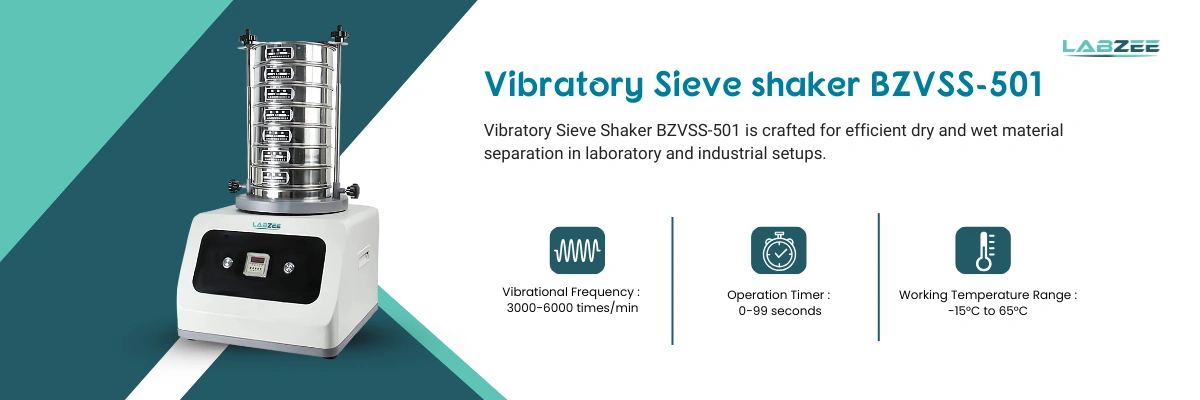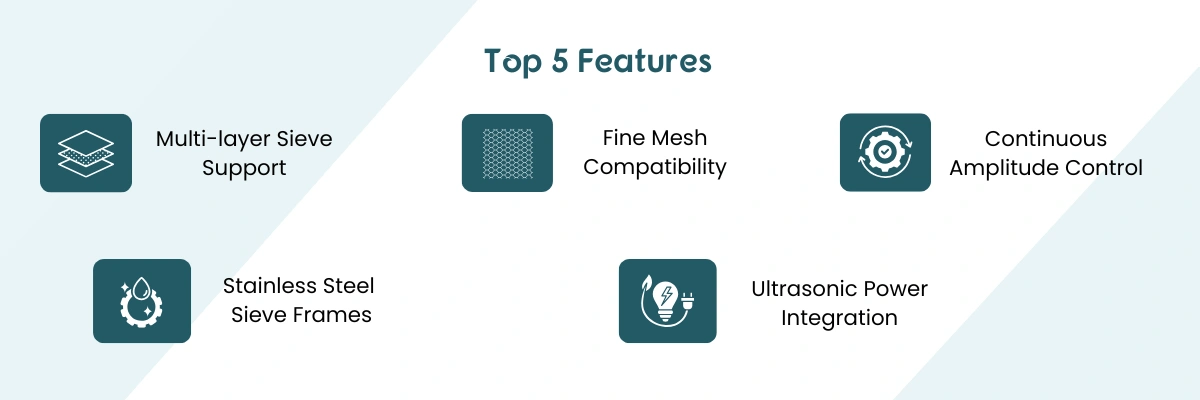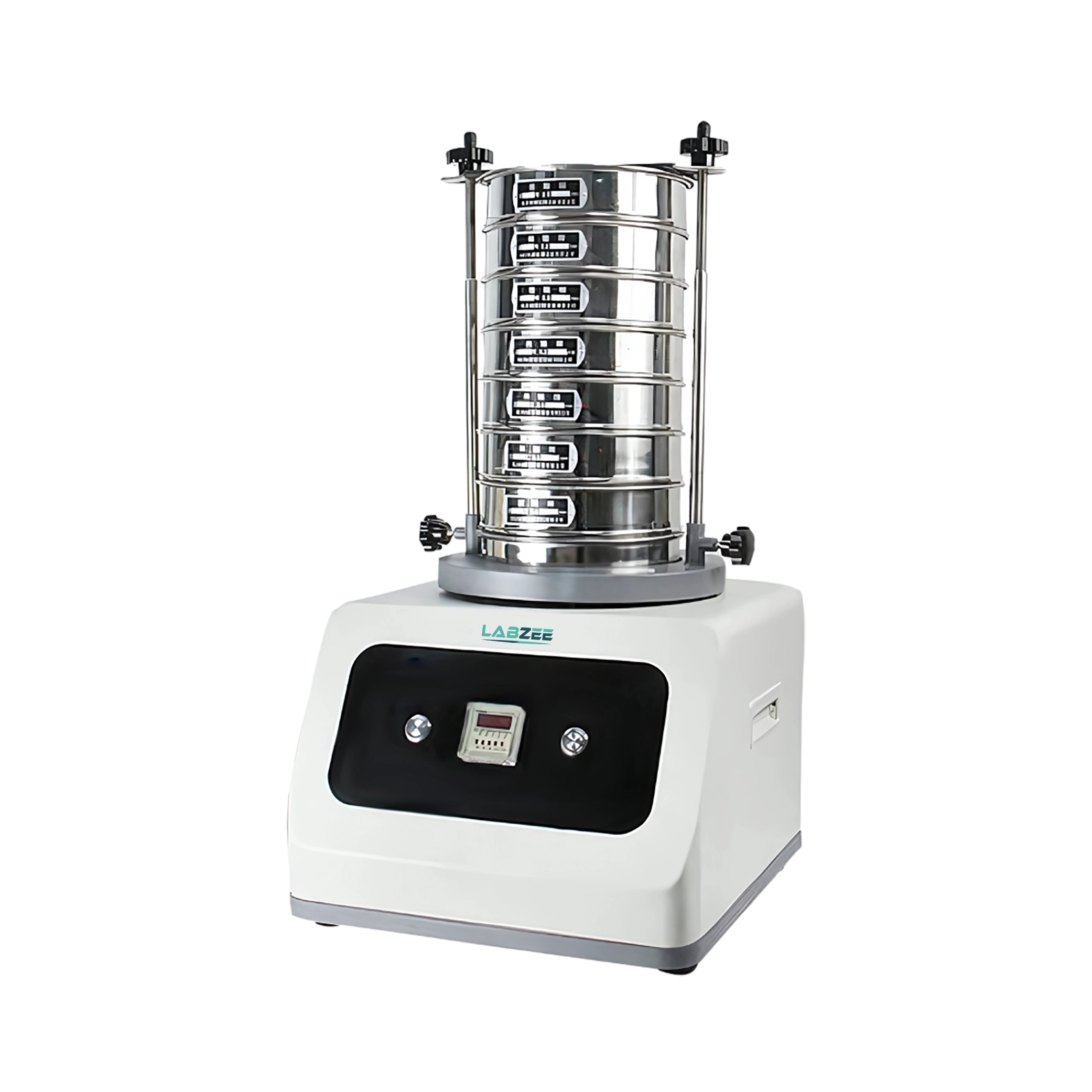
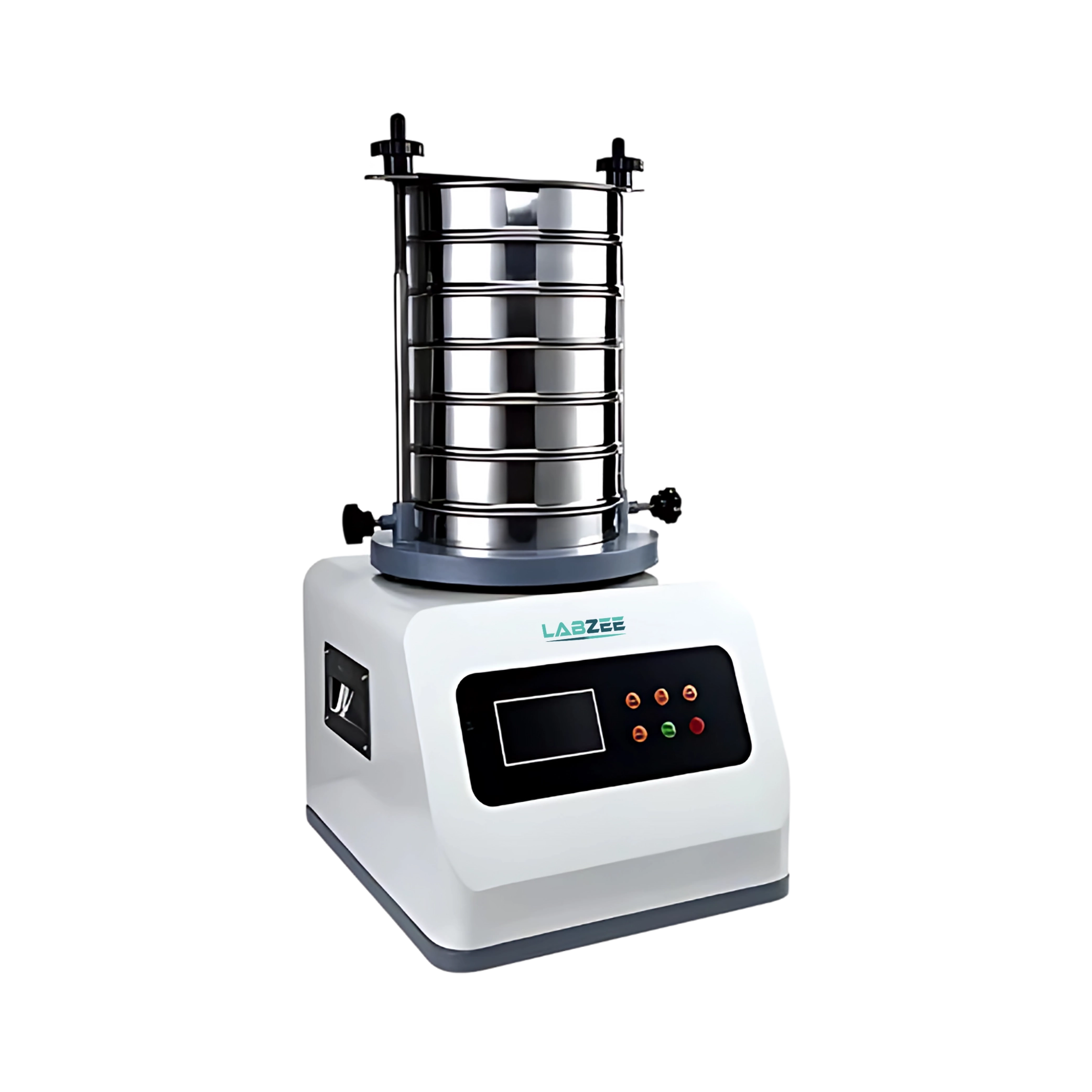
Vibratory Sieve Shaker BZVSS-501 is crafted for efficient dry and wet material separation in laboratory and industrial setups. This sieve shaker features a vibrational frequency range of 3000 to 6000 times per minute, adjustable amplitude up to 3 mm, and load support for up to 3 kilograms. It enables precise screening using multiple mesh layers while maintaining stable, low-noise performance. Its sealed, stainless-steel design supports both fine and coarse material testing without contamination. Our Vibratory Sieve Shaker BZVSS-501 is widely used in pharmaceuticals, metallurgy, ceramics, food production, and chemical powder analysis.
| Sieve Material | Stainless Steel |
| Vibrational Frequency | 3000-6000 times/min |
| Operation Timer | 0-99 seconds |
| Working Temperature Range | -15°C to 65°C |
| Sieve Diameter | 200 mm |
| Powder Sieve Diameter | 200 mm |
| Number of Sieve Layers | 1-7 layers (customizable) |
| Sieve Machine Speed | 1140 rpm |
| Load Capacity | 3 Kg |
| Amplitude Range | 0-3 mm (continuously adjustable) |
| Mesh Range | 20-1000 mesh |
| Sieving Class | Powder, Loose Particles, Suspended Matter |
| Sieve Type | Dry and Wet |
| Sieve Machine Power | 120 W ultrasonic (range 30-150 W) |
| Power Consumption | 220 W |
| Power Supply | AC 220V ±25%, 50Hz ±1Hz |
| Net Weight | 30 Kg |
Our Vibratory Sieve Shaker BZVSS-501 is ideal for multi-level particle size classification in pharmaceutical R&D, mesh calibration in metallurgy, fine powder screening in ceramic labs, suspended matter analysis in food technology, and dry or wet testing in chemical powder refinement.
Frequently Asked Questions
1: How does a vibratory sieve shaker work?
It uses controlled vibrations to move material across stacked sieves, helping you separate particles by size efficiently.
2: What industries commonly use vibratory sieve shakers?
You’ll find them in pharmaceuticals, food, construction, and research labs-anywhere accurate particle sizing is needed.
3: Can you run wet sieving with a vibratory shaker?
Yes, some models support wet sieving if you add a water spray system and use appropriate sieves.
4: How many sieves can you stack at once?
You can usually stack 5 to 8 sieves, depending on the model, giving you multiple separation levels in one run.
5: What power supply is typically required?
Most vibratory sieve shakers run on standard AC power but always check your model's voltage requirements.
6: What does a vibratory sieve shaker do?
A vibratory sieve shaker helps you separate particles by size using vibration. It ensures accurate and efficient particle size analysis.
7: Can you use multiple sieves at once?
Yes, you can stack multiple sieves to sort materials into different size ranges during a single operation.
8: Is the vibration intensity adjustable?
Most models let you adjust the vibration intensity, so you can match the settings to your material’s characteristics.
9: What materials can you test with it?
You can use it to test powders, granules, aggregates, and other bulk materials commonly used in labs and industries.
10: Is it easy to change or clean the sieves?
Yes, the sieves are easy to insert, remove, and clean, helping you switch materials or mesh sizes quickly.
11: Can you control both temperature and shaking speed on a Vertical Incubator Shaker?
Yes, these devices come with programmable controls that let you set precise temperature ranges and shaking speeds. This ensures stable and repeatable conditions for sensitive experiments or microbial cultivation.