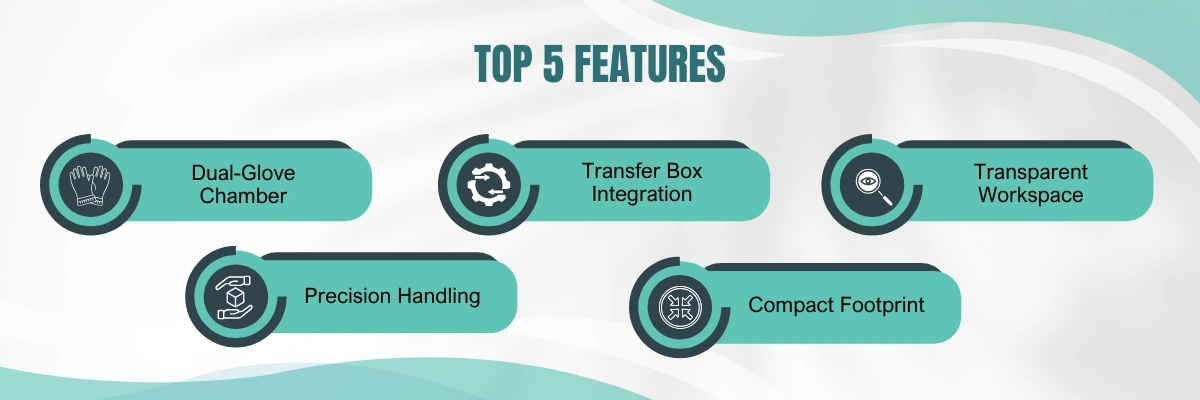
Acrylic Glove Box BZAGB-509B is designed to maintain an isolated workspace for operations involving sensitive or hazardous materials. This Glove Box features a 1000 × 700 × 500 mm main chamber, 240 × 240 × 240 mm transition box, and a 2-glove configuration to facilitate secure sample handling and internal transfers. It is made of 10 mm thick PMMA, it offers excellent clarity and chemical resistance while ensuring a sturdy enclosure for precision work. Its ergonomic layout enhances user comfort during prolonged use while protecting internal conditions from external exposure. Our Acrylic Glove Box BZAGB-509B is suited for applications in chemical testing, electronic diagnostics, cleanroom environments, and contamination-sensitive research.
| Main Box Dimension | 1000 × 700 × 500 mm |
| Material | PMMA |
| PMMA Thickness | 10 mm |
| Left Round Door | 300 mm |
| Gloves | 2 |
| Transition Box | Yes |
| Transition Box Dimension | 240 × 240 × 240 mm |
| Product Dimension | 100 × 70 × 50 cm |
| Package Dimension | 158 × 78 × 75 cm |
| Net Weight | 90 Kg |
| Gross Weight | 98 Kg |
Our Acrylic Glove Box BZAGB-509B supports work in sterile and sensitive lab environments including pharmaceutical compounding, microelectronics repair, and nanomaterial development. It provides an effective safeguard for operations requiring isolation from air and particles. The integrated transition box allows seamless material transfer without exposure, improving workflow efficiency and safety.
Frequently Asked Questions
1: Can the Acrylic Surface Scratch Easily?
While PMMA is durable, it can scratch if handled roughly or cleaned with abrasive materials. Use soft cloths and non-abrasive cleaners. Avoid dragging tools or containers across surfaces. With proper care, the panels maintain their clarity and strength. Protective films may also be applied if needed.
2: Are There Electrical Feedthrough Options?
Standard models do not include electrical ports, but they can be added on request. Custom feedthroughs can support instruments, sensors, or wiring for heaters and lights. They are sealed to maintain vacuum integrity. Electrical integration expands the box’s functionality in complex experiments.
3: Can the Acrylic Glove Box Be Mounted or Fixed to a Table?
Yes, the base structure allows mounting or fixing to laboratory tables. This prevents accidental movement during use. Rubber feet or clamps are often used to secure the unit. Stability is essential during precise manipulations. Larger models may include anchoring brackets.
4: What Is the Weight of the Acrylic Glove Box?
The weight depends on size, but a standard 1000×600×700 mm unit may weigh 20–35 kg. It is light enough to move with assistance, yet heavy enough to remain stable. Thicker acrylic panels add to the weight. Handling should be done with care to avoid cracks.
5: Is It Safe to Transport the Acrylic Glove Box?
Yes, but precautions must be taken. Ensure the unit is empty and gloves are secured. Use cushioning to protect corners and valves. The transparent structure should be wrapped to prevent scratches. It should be lifted from the base, not the ports or accessories.
6: What Is an Acrylic Glove Box Used For?
An Acrylic Glove Box is used to create a sealed and controlled environment for conducting experiments. It helps isolate materials from air, moisture, dust, and contaminants. This makes it suitable for chemical, biological, or electronic research. Users can manipulate objects inside safely through attached gloves. It’s essential for clean and precise lab work.
7: What Materials Are Used in This Acrylic Glove Box?
The Acrylic Glove Box is made of clear, durable acrylic panels, providing high visibility and structural strength. It features latex gloves for hand access, which are soft and flexible. Gas inlet and outlet valves are made of stainless steel, offering durability and corrosion resistance. All materials are chosen for lab safety and reliability.
8: Is the Acrylic Glove Box Airtight?
Yes, the Acrylic Glove Box is designed to be airtight. The front door uses a sealing gasket and latches to prevent any air exchange with the outside. This ensures a stable atmosphere inside, which is crucial for sensitive tasks. Airtightness also protects both users and contents from contamination. It maintains the integrity of experiments.
9: How Do You Introduce Gas Into the Acrylic Glove Box?
Gas is introduced through the stainless steel inlet and outlet valves built into the Acrylic Glove Box. These valves allow you to purge the interior with inert gases like nitrogen or argon. This helps in creating a dry and oxygen-free environment. The process is straightforward and supports many types of scientific experiments. Pressure can be controlled safely.
10: Can the Acrylic Glove Box Be Used for UV Experiments?
Yes, the Acrylic Glove Box can support UV-based experiments. Its clear acrylic body allows limited UV transmission, which is useful for sterilization or polymer curing. However, compatibility depends on the wavelength of UV light used. It’s ideal for microbiology work or UV testing when used properly. Always follow safety guidelines when using UV light.