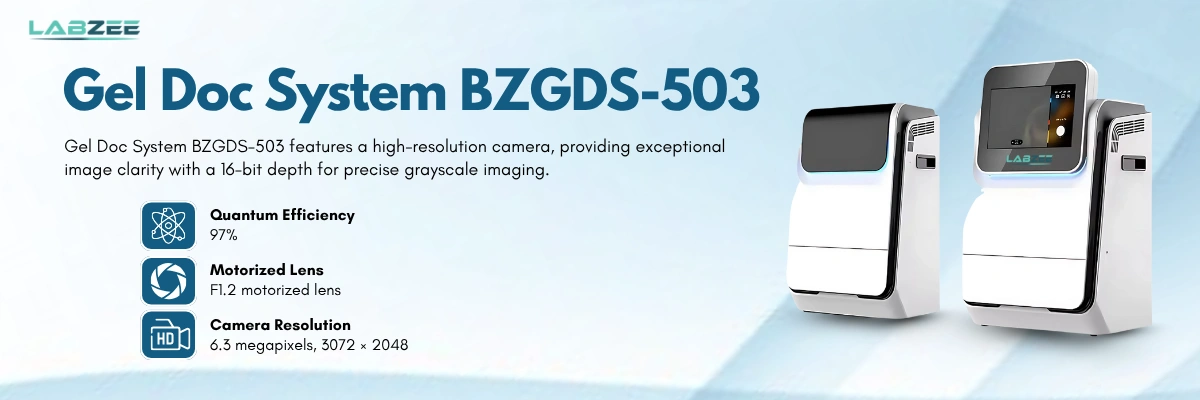
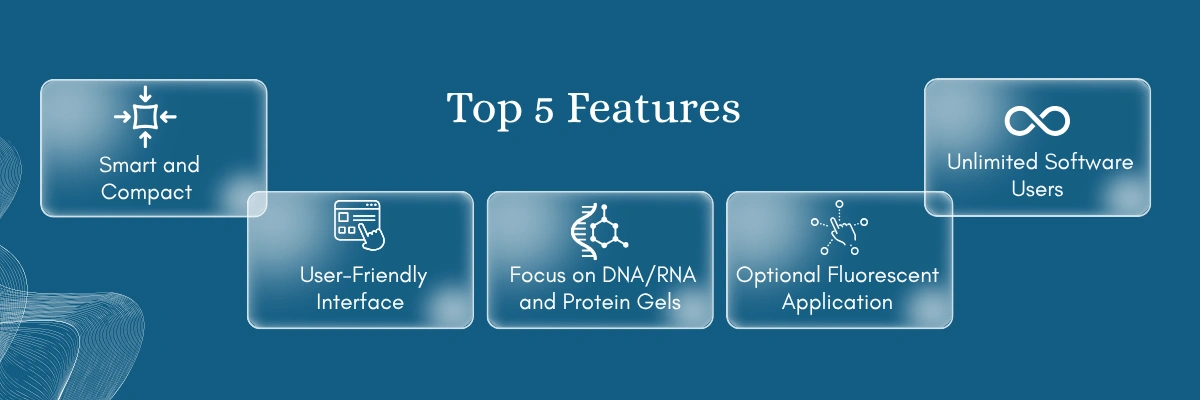
Gel Doc System BZGDS-503 features a high-resolution camera, providing exceptional image clarity with a 16-bit depth for precise grayscale imaging. It has outstanding quantum efficiency, ensuring superior sensitivity to detect even trace amounts of DNA with EB staining. This device includes motorized lenses and multiple sample trays, one designed for DNA/RNA with UV LED transmission and another for protein gels with white LED transmission. It is designed to be smart and compact, optimizing space usage. Our Gel Doc System BZGDS-503 offers an optional removable industrial computer to enhance processing speed and reliability while reducing after-sales concerns.
| Camera Resolution | 6.3 megapixels, 3072 × 2048 |
| Pixel Density | 16 bits (65536 Grey scale) |
| Quantum Efficiency | 97% |
| Sensitivity | Lower than 5pg EB stained DNA |
| Motorized Lens | F1.2 motorized lens |
| Gel Doc Sample Tray | DNA//RNA sample tray: 17x13cm, UV LED Transmission |
| Protein Gels Sample Tray | White LED transmission: 17x13cm |
• Blue LED transmission
• Industrial Computer with Intel Processor
The Gel Doc System BZGDS-503 is used for imaging and documentation of DNA/RNA and protein gels with high sensitivity and clarity. Equipped with a scientific-grade camera, UV LED transilluminator, and a special filter, it ensures accurate and reliable results. Ideal for molecular biology labs for nucleic acid and protein analysis.
Frequently Asked Questions
1: What makes the BZGDS-503 better at detecting faint DNA bands?
The BZGDS-503 uses a high-sensitivity camera with 16-bit grayscale depth and 97% quantum efficiency, which enables it to capture even faint EB-stained DNA bands as low as 5 pg.
2: How large of a gel can I image with the BZGDS-503?
Both the DNA/RNA and protein gel trays can accommodate gels up to 17 × 13 cm, which is suitable for most routine electrophoresis applications.
3: Is the BZGDS-503 portable or fixed?
Though not handheld, the BZGDS-503 is compact and lightweight enough to be relocated within lab benches or between rooms with ease.
4: What are the energy requirements of BZGDS-503?
The BZGDS-503 is designed for low power consumption, typically under 100W, and works with standard AC input (110–240V) without requiring a stabilizer.
5: Is the BZGDS-503 noisy or disruptive in a quiet lab setting?
No. The BZGDS-503 is designed to be ultra-quiet and vibration-free, making it suitable for both research and clinical environments.
6: What types of gels can I image?
You can image agarose gels (e.g., DNA stained with Ethidium Bromide or SYBR Safe), polyacrylamide gels, and protein gels stained with Coomassie Blue or silver stain.
7: Does the system require a darkroom?
No. Gel Doc systems are self-contained with light-tight enclosures, so no separate darkroom is required.
8: What light sources are used for illumination?
Most Gel Docs include UV transilluminators. Some also feature white light or blue light (for non-toxic dyes) as additional options.