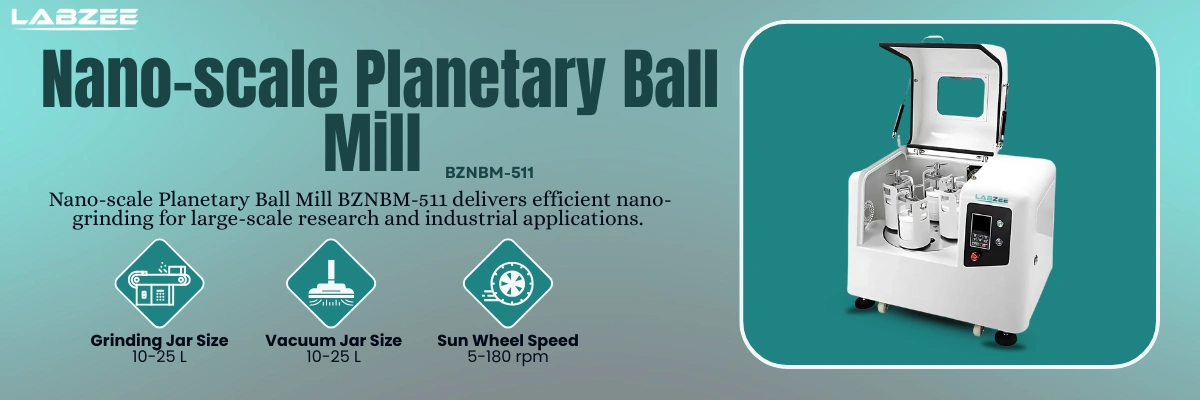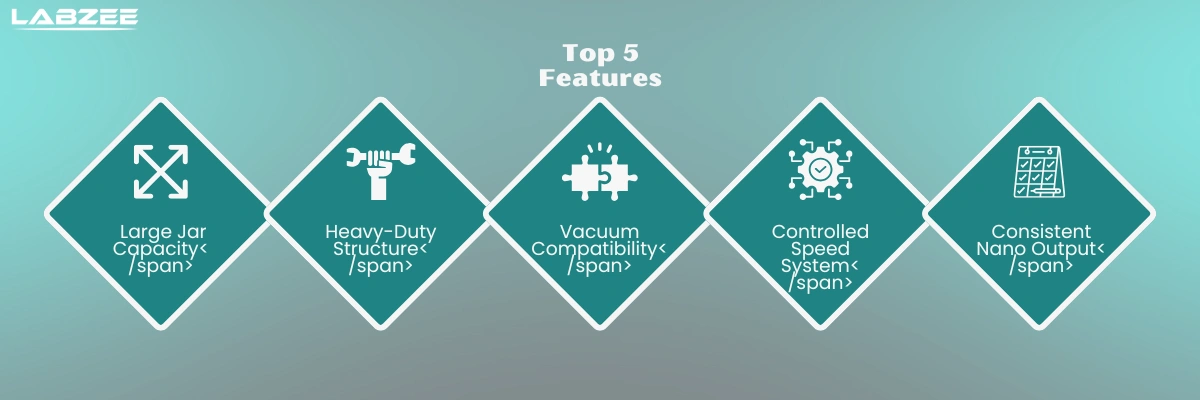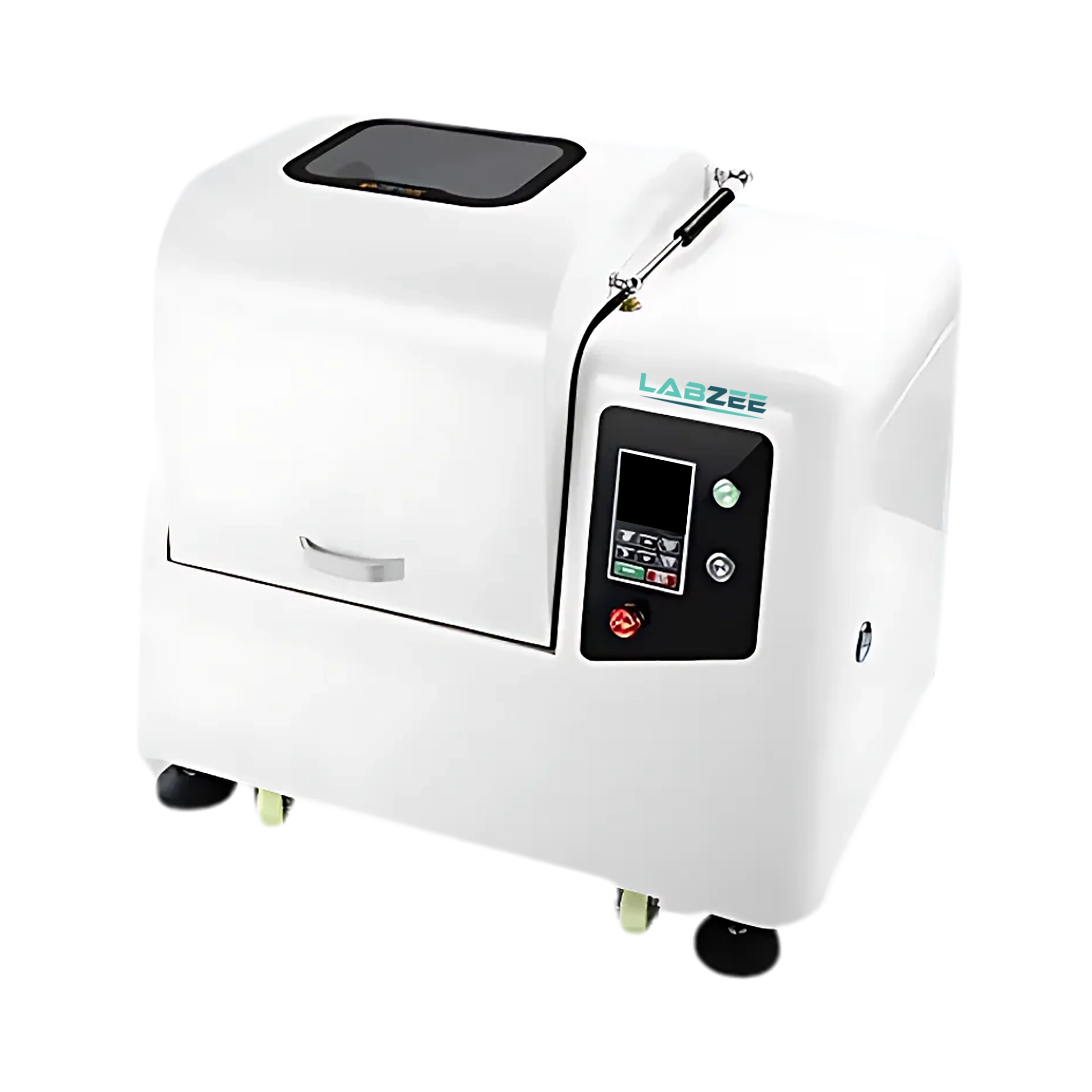
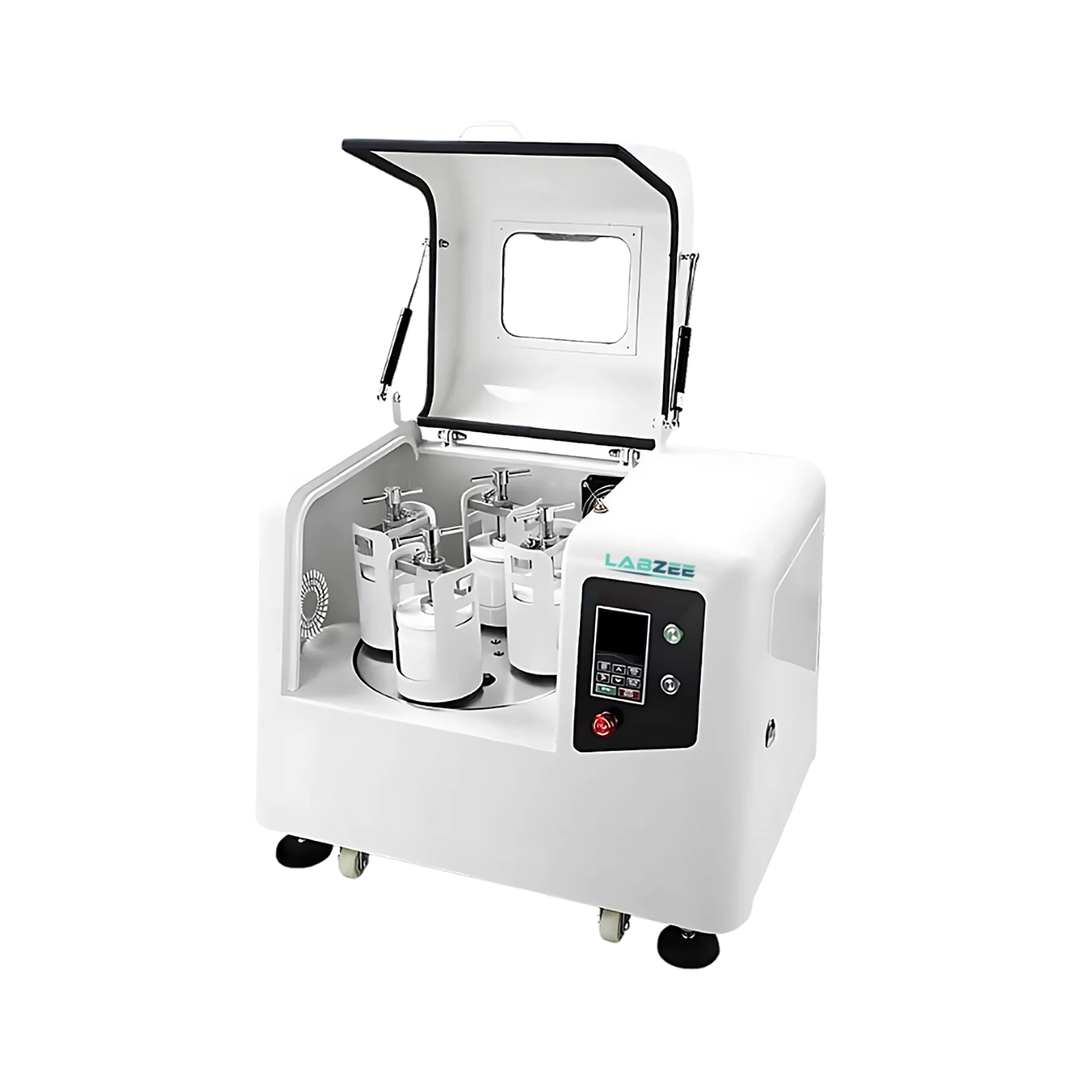
Nano-scale Planetary Ball Mill BZNBM-511 delivers efficient nano-grinding for large-scale research and industrial applications. It supports both grinding and vacuum jars from 10 to 25 L, allowing extended and high-capacity processing. It features a stable transmission mechanism and optimized speed control to produce ultra-fine, uniform particles. Its robust power system ensures consistent performance across varying material types. Our Nano-scale Planetary Ball Mill BZNBM-511 is suitable for producing nano-coatings, catalyst powders, ceramic slurries, pharmaceutical precursors, and advanced research samples.
| Grinding Jar Size | 10-25 L |
| Vacuum Jar Size | 10-25 L |
| Sun Wheel Speed | 5-180 rpm |
| Ball Mill Jar Speed | 10-360 rpm |
| Power | 15 kW |
| Voltage | AC 380V, 50Hz |
| Product Dimensions | 140 × 110 × 116 cm |
| Weight | 1059 Kg |
Our Nano-scale Planetary Ball Mill BZNBM-511 ensures scalable nano-powder processing for catalysts, ceramics, specialty chemicals, medical formulations, and energy materials in demanding R&D and industrial setups.
Frequently Asked Questions
1: Is training needed before using it?
Yes, basic training is recommended to understand the settings, safety protocols, and handling procedures before starting your milling work.
2: How is this different from other ball mills you may use?
This mill uses high energy and precise control to reach nano-scale particles. It's more advanced than basic mills, offering better results.
3: Can you use it to make pigments?
Yes, it’s widely used for pigment production. You can get uniform colors and fine particle sizes for use in coatings, inks, and paints.
4: Are there moving parts you shouldn't touch?
Yes, never touch rotating jars or internal components while the machine is running. Always wait for it to stop completely before opening.
5: Is this machine good for academic labs you work in?
Yes, it's excellent for teaching and research labs. It offers precise control, compact design, and the ability to process small samples efficiently.
6: What is a Nano-scale Planetary Ball Mill?
A Nano-scale Planetary Ball Mill is a high-energy milling system specifically designed to grind materials down to the nanometer range. It is widely used in advanced research and material science for producing ultra-fine powders and nanoparticles.
7: What makes this mill suitable for nano-scale grinding?
Its powerful centrifugal forces and rapid rotation of grinding jars provide intense impact and friction, enabling particle size reduction to below 100 nanometers. The precise control of speed and time ensures reproducible nano-level results.
8: What applications require nano-scale milling?
Applications include nanomaterials synthesis, battery material preparation, catalyst development, pharmaceuticals, ceramics, and advanced composites where ultra-fine particle sizes are critical for performance.
9: What types of grinding media are recommended for nano-scale milling?
High-density and contamination-free media such as zirconia, tungsten carbide, or agate are commonly used to achieve efficient nano-grinding without affecting sample purity.
10: How can overheating be prevented during nano-scale milling?
Overheating can be minimized using intermittent milling cycles, built-in cooling systems, or by selecting jars with thermal insulation. Proper speed settings and milling durations also help manage heat generation effectively.