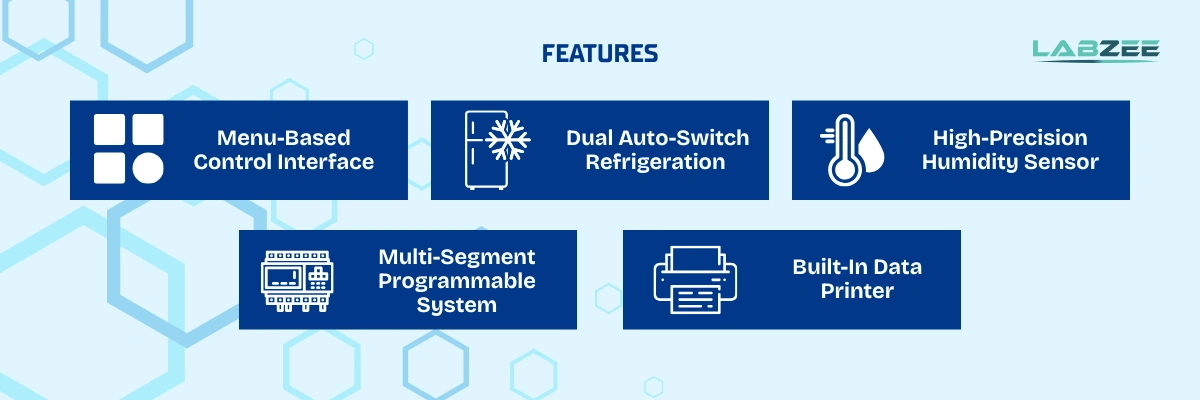
Labzee Pharmaceutical Light Stability Chamber BZML-503 is designed for stable and programmable testing under controlled environmental conditions. Its temperature range extends from 4°C to 60°C without light and 10°C to 60°C with light, with temperature uniformity of ±2°C. The PID microprocessor controller enables high-precision adjustments, ensuring stable and consistent test conditions. Its large LCD screen displays real-time temperature, humidity, and lighting data simultaneously and features a menu-driven interface for intuitive operation. Our Pharmaceutical Light Stability Chamber BZML-503 is ideal for photo-stability chambers, drug stability testing, and environmental condition simulation.
| Chamber Volume | 375 L |
| Temperature Range With Light | 10 to 60℃ |
| Temperature Range Without Light | 4 to 60℃ |
| Temperature Fluctuation | ±0.5℃ |
| Temperature Uniformity | ±2℃ |
| Operating Temperature | 5 to 30℃ |
| Humidity Range | 30 to 95% RH |
| Humidity Stability | ±3%RH |
| Light Intensity (LX) | 0 to 6000 (step control) |
| Timing Range | 1 to 99 Hours / Period |
| Sensor | PT100 Capacitance Sensor |
| Temp. And Humidity Adjusting | Balance Temperature And Humidity Adjusting |
| Power Supply | AC 220v, 50Hz |
| Power Consumption | 2700W |
| Chamber Size (W×D×H) | 59×55×116 cm |
| Exterior Size (W×D×H) | 78×87×191.5 cm |
3 Grids (Expandable to 10)
Labzee Pharmaceutical Light Stability Chamber BZML-503 is ideal for pharmaceutical stability testing, including accelerated aging, long-term storage, high humidity exposure, and photo stability assessments.
Frequently Asked Questions
1: How is light intensity controlled and monitored?
Light intensity is step-adjustable up to 6000 Lux, allowing precise control of exposure levels. The system provides digital monitoring and ensures consistent intensity throughout the test period.
2: Can Pharmaceutical Light Stability Chamber BZML-503 simulate multiple environmental conditions in a single test cycle?
Yes. With a multi-segment programmable controller, you can configure sequential changes in temperature, humidity, and light intensity, enabling simulation of complex real-world conditions in a single automated program.
3: How is temperature and humidity accuracy maintained during long-term tests?
A PID microprocessor precisely controls the internal environment, while dual auto-switch refrigeration systems and a balanced humidity adjustment mechanism maintain stable conditions even over extended periods.
4: What type of sensor is used for environmental monitoring?
The system uses a high-precision PT100 capacitance sensor, which offers accurate and reliable readings of temperature and humidity throughout the test area.
5: Does the chamber require a dedicated water source for humidity control?
No. Pharmaceutical Light Stability Chamber BZML-503 is equipped with an external water tank that supplies water for humidity control, eliminating the need for a plumbed connection and simplifying installation.
6: What are Pharmaceutical Light Stability Chambers used for?
Pharmaceutical Light Stability Chambers are used to test the photostability of pharmaceutical products, packaging materials, and raw ingredients under controlled light conditions.
7: What type of lighting is used inside the chambers?
Our Pharmaceutical Light Stability Chambers use UV and visible fluorescent lamps with programmable light intensity, often ranging from 0 to 6000 Lux, to simulate daylight exposure.
8: Can temperature and humidity be controlled during testing?
Yes. Our chambers provide precise temperature and humidity control, with tight tolerances (e.g., ±0.5°C and ±3% RH), even under illuminated conditions.
9: How is light intensity monitored and controlled?
Built-in light sensors continuously monitor UV and visible light levels. The system allows step-controlled or programmable light exposure for reproducibility and compliance.
10: What safety features are included in these chambers?
Safety features include temperature-limiting alarms, UV protection shields, auto-shutdown mechanisms, and system diagnostics.