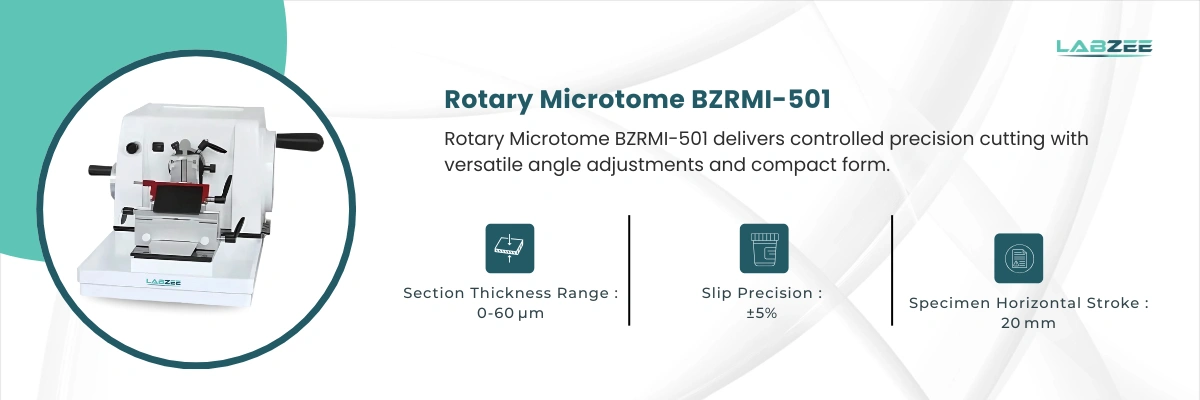
Rotary Microtome BZRMI-501 delivers controlled precision cutting with versatile angle adjustments and compact form. This microtome features 0-60 µm section range and ±5% slip precision for accurate, uniform slicing of biological samples. It offers adjustable blade positioning and full-angle specimen clamping for enhanced alignment. Its ergonomic design ensures smooth mechanical operation and stability during repetitive use. Our Rotary Microtome BZRMI-501 is ideal for use in histopathological research, anatomical tissue analysis, and molecular biology labs.
| Section Thickness Range | 0-60 µm |
| Section Thickness Setting | 0-2 µm (0.5 µm steps); 2-10 µm (1 µm steps); 10-20 µm (2 µm steps); 20-60 µm (5 µm steps) |
| Slip Precision | ±5% |
| Specimen Horizontal Stroke | 20 mm |
| Specimen Vertical Stroke | 50 mm |
| Max Specimen Dimension | 50 × 45 mm |
| Specimen Clamp Angle Adjustment | Horizontal 8°, Vertical 8°, Rotational 360° |
| Blade Holder Movement Range | ±25 mm (front-back), ±25 mm (left-right) |
| Blade Holder Angle | 0-10° |
| Product Dimension | 500 × 480 × 280 mm |
| Package Dimension | 520 × 520 × 450 mm |
| Net Weight | 30 Kg |
| Gross Weight | 41 Kg |
| Packaging Type | Wooden Case |
Disposable Blade Holder × 1 Piece
Specimen Cassette × 1 Piece
Hexagonal Wrench × 1 set
Brush × 1 Piece
Our Rotary Microtome BZRMI-501 facilitates the preparation of thin, precise tissue sections for microscopic examinations in histology, pathology, and advanced biological research, providing consistent slicing performance and customizable blade alignment for research-grade sectioning.
Frequently Asked Questions
1: Can you elaborate on the section thickness settings of this microtome?
Yes, the Rotary Microtome BZRMI-501 offers a section thickness range from 0 to 60?µm with multiple step options, enabling flexibility in preparing sections for different tissue types and resolutions.
2: What type of specimen alignment features does it include?
The unit provides horizontal, vertical, and full 360° rotational clamp angle adjustments, ensuring precise alignment and orientation of specimens during sectioning.
3: How does blade positioning improve usability?
It includes ±25?mm movement range in both front-back and left-right directions, along with adjustable blade angles, offering enhanced control and ease during blade setup.
4: Is the device suitable for detailed tissue research?
Absolutely, its precision slicing capability and stable mechanical operation make it ideal for research applications requiring thin and consistent tissue sections.
5: Can you explain the build and packaging of this model?
The microtome has a compact and sturdy build, packed securely in a wooden case for safe transportation and long-term storage, especially suited for lab-grade use.
6: When is a Rotary Microtome used in histology?
It is used to cut paraffin-embedded tissue into thin sections for slide preparation. The rotary design ensures smooth and consistent sectioning. It is ideal for routine pathology workflows.
7: Can section thickness be finely adjusted?
Yes, Rotary Microtomes allow precise adjustment of thickness, often from 1-60 µm. Fine tuning ensures reproducible cuts for various tissue types. This enhances quality in microscopic examination.
8: Can it accommodate different blade types?
Yes, most rotary models are compatible with both low- and high-profile blades. Blade holders are adjustable for user preference and block type. This flexibility supports diverse sample processing.
9: When should maintenance be performed?
Routine cleaning after each session and weekly inspection of moving parts is recommended. Lubrication and blade alignment checks ensure long-term precision. Proper care extends instrument life.
10: Can it be used for hard or calcified tissues?
Yes, with appropriate blades and slower cutting speed, it can handle denser tissues. However, extremely hard samples may require decalcification or specialized equipment. Always assess the sample before sectioning.