
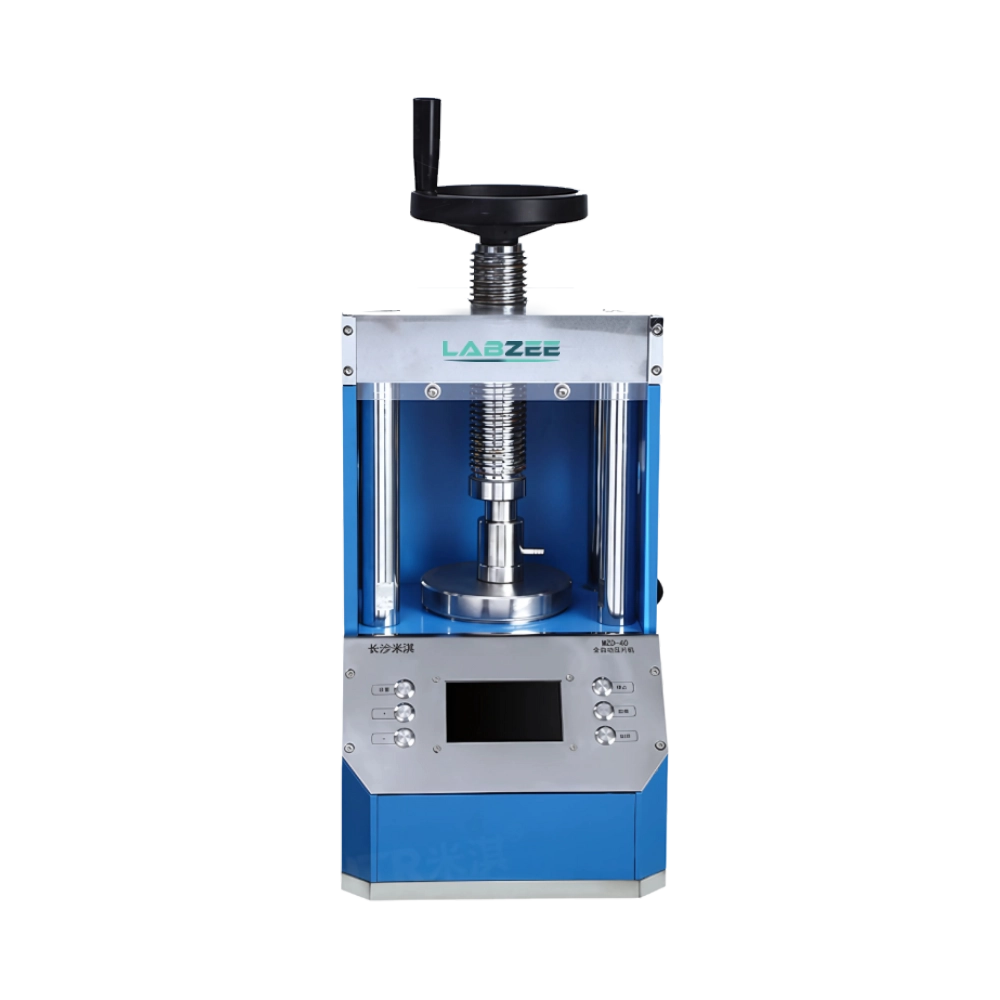

Automatic Tablet Press BZATP-501 delivers consistent and precise compaction through its advanced design. This Automatic Tablet Press supports a pressure range from 0.2 to 20 tons with a timed multi-step pressurization process and automatic mold pressure adjustment. It operates through a 4.3-inch LCD screen with pressure holding capability from 1 second to continuous. Its automatic pressure relief and mold calibration ensure optimal safety and uniformity. Our Automatic Tablet Press BZATP-501 is ideal for tablet preparation in laboratories, material research, pharmaceutical testing, and catalyst formation.
| Pressure range | 0.2-20 tons |
| Pressure process | Timed Multi-Step Pressurization |
| Pressure holding time | 1 s to ∞ s |
| Pressure conversion | Auto Mold Pressure Adjustment |
| LCD display | 4.3-inch LCD screen |
| Limit switch | Auto Pressure Relief at Limit |
| Cylinder stroke | 30 mm |
| Spatial dimensions | 140 × 160 mm |
| Power Consumption | 550 W (Customizable) |
| Power Supply | AC 220V 50/60 Hz |
| Product Dimension | 230 × 390 × 420 mm |
| Net Weight | 90 Kg |
Our Automatic Tablet Press BZATP-501 is used in tablet preparation for pharmaceutical formulations, polymer composites, and advanced material research. It also supports compacting catalysts, fine powders, and metallurgical samples with precise control. This model is ideal for laboratories handling ceramics, fertilizers, electronic components, and pharmaceutical dosage form testing.
Frequently Asked Questions
1: What is the difference between single and multi-station tablet presses?
Single station presses make one tablet at a time; multi-station (rotary) presses produce multiple tablets simultaneously at higher speeds.
2: What is turret speed and why is it important?
Turret speed determines how fast tablets are produced; higher speeds increase output but may affect quality.
3: What industries use automatic tablet presses?
Automatic tablet presses are widely used in pharmaceutical, nutraceutical, chemical, and food industries. They are ideal for mass production where precise dosages and uniformity are critical. Cosmetic companies may also use them for compact products.
4: How is tablet weight controlled?
Tablet weight is controlled by adjusting the powder fill depth in the die. This is managed by the lower punch's position. Accurate control ensures uniformity and compliance with dosage specifications.
5: Can the machine handle different formulations?
Yes, most machines are designed to work with various powders and granules. Adjustments in speed, pressure, and fill depth help accommodate different flow properties. Consistency and compatibility tests are usually required first.
6: What is pre-compression?
Pre-compression lightly compresses powder before the main compression. It removes trapped air and improves powder bonding. This step is useful for reducing defects like capping or lamination in high-speed production.
7: What is an automatic tablet press?
An automatic tablet press is a mechanical device used to compress powder into tablets of uniform size, shape, and weight.
8: What are the main components of a tablet press?
Key components include the hopper, feeder, dies, punches, turret, compression rollers.
9: What industries use automatic tablet presses?
Pharmaceutical, nutraceutical, chemical, food, and cosmetics industries commonly use tablet presses.
10: How does an automatic tablet press work?
It feeds powder into a die, compresses it using punches, and ejects the formed tablet continuously.
11: What types of tablets can be produced?
It can produce round, oval, multi-layered, engraved, or custom-shaped tablets.

