
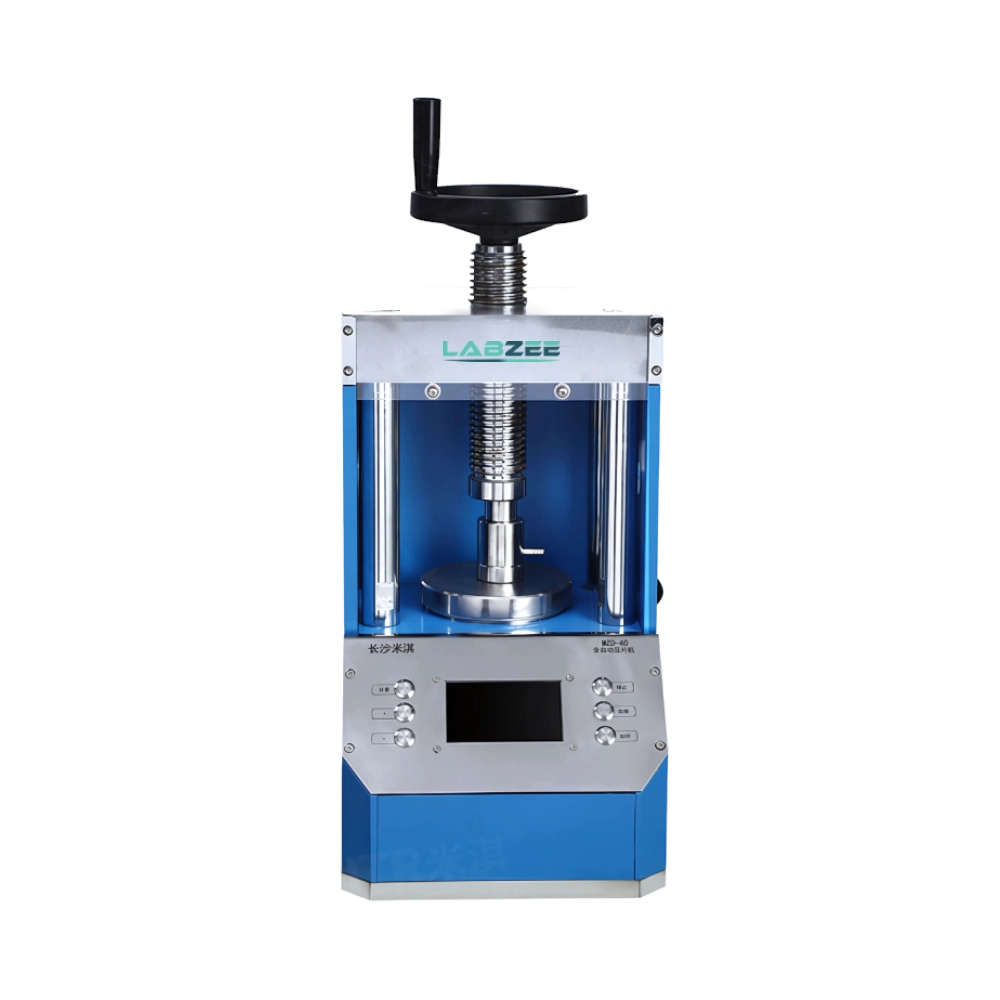

Automatic Tablet Press BZATP-503 is designed for high-precision tablet and pellet formation in advanced lab environments. This Automatic Tablet Press supports a pressure range from 0.2 to 30.0 tons with a timed multi-step pressurization process and automatic mold pressure adjustment. It is equipped with a 7-inch IPS HD touchscreen for intuitive control and real-time monitoring. It ensures optimal consistency in compaction cycles and integrates limit-based automatic pressure relief for enhanced safety. Our Automatic Tablet Press BZATP-503 is ideal for demanding material research and precision powder pressing.
| Pressure range | 0.2-30.0 tons |
| Pressure process | Timed Multi-Step Pressurization |
| Pressure holding time | 1 s to ∞ s |
| Pressure conversion | Auto Mold Pressure Adjustment |
| LCD display | 7-inch (IPS HD) Touch Screen |
| Limit switch | Auto Pressure Relief at Limit |
| Cylinder stroke | 30 mm |
| Spatial dimensions | 140 × 160 mm |
| Power Consumption | 550W (Customizable) |
| Power Supply | AC 220V 50/60 Hz |
| Product Dimension | 230 × 390 × 420 mm |
| Net Weight | 95 Kg |
Our Automatic Tablet Press BZATP-503 is extensively used for forming pharmaceutical tablets, research composites, battery powders, and ceramic materials in R&D centers. It plays a key role in compacting rare earth powders, nanomaterials, fuel cell elements, and magnetic compound layers.
Frequently Asked Questions
1: Can the machine produce multi-layer tablets?
Yes, specialized models support multi-layer tablet production. Each layer is filled and compressed sequentially. This allows for combination drugs or controlled-release formats in a single tablet.
2: Does it support tablet engraving or embossing?
Yes, punches can be customized with engravings for logos, numbers, or score lines. These features enhance branding and aid in dosage identification. Consistent pressure is needed to maintain clarity.
3: What control systems are used?
Modern tablet presses use PLC-based systems with touchscreen interfaces. These systems manage speed, pressure, weight, and alarms. Some models also allow remote monitoring and automated adjustments.
4: Is data logging and batch tracking available?
Yes, many machines offer data logging for pressure, speed, and weight. Batch tracking ensures traceability for regulatory compliance. This is especially important in pharmaceutical manufacturing.
5: Can you integrate it with upstream and downstream equipment?
Yes, tablet presses can be integrated with feeders, dedusters, metal detectors, and coating machines. Integration improves efficiency, reduces manual handling, and supports continuous production.
6: What is an automatic tablet press?
An automatic tablet press is a mechanical device used to compress powder into tablets of uniform size, shape, and weight.
7: What are the main components of a tablet press?
Key components include the hopper, feeder, dies, punches, turret, compression rollers.
8: What industries use automatic tablet presses?
Pharmaceutical, nutraceutical, chemical, food, and cosmetics industries commonly use tablet presses.
9: How does an automatic tablet press work?
It feeds powder into a die, compresses it using punches, and ejects the formed tablet continuously.
10: What types of tablets can be produced?
It can produce round, oval, multi-layered, engraved, or custom-shaped tablets.

