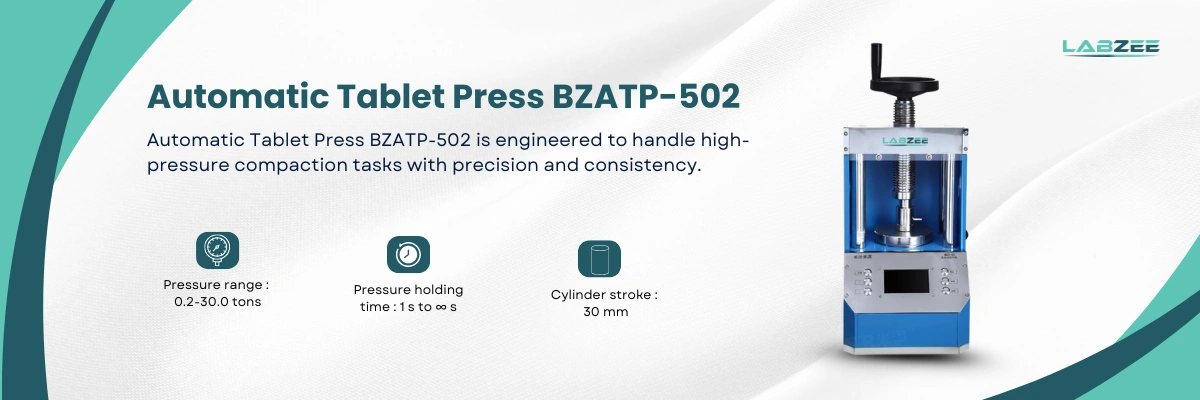
Automatic Tablet Press BZATP-502 is engineered to handle high-pressure compaction tasks with precision and consistency. This Automatic Tablet Press supports a pressure range from 0.2 to 30.0 tons with a timed multi-step pressurization process and automatic mold pressure adjustment. It is equipped with a 7-inch IPS HD touchscreen for monitoring parameters and adjusting settings effortlessly. It ensures pressure relief at limit points and maintains consistent holding time for all pressing stages. Our Automatic Tablet Press BZATP-502 is the preferred solution for advanced powder pressing and research-grade material formation.
| Pressure range | 0.2-30.0 tons |
| Pressure process | Timed multi-step pressurization |
| Pressure holding time | 1 s to ∞ s |
| Pressure conversion | Auto Mold Pressure Adjustment |
| LCD display | 7-inch (IPS HD) touch screen |
| Limit switch | Auto pressure relief at limit |
| Cylinder stroke | 30 mm |
| Spatial dimensions | 140 × 160 mm |
| Power Consumption | 550 W (Customizable) |
| Power Supply | AC 220V 50/60 Hz |
| Product Dimension | 230 × 390 × 420 mm |
| Net Weight | 95 Kg |
Our Automatic Tablet Press BZATP-502 is used in pharmaceutical formulation, tablet prototyping, and material sciences for pressing active ingredients and composites. It facilitates compacting ceramics, polymers, catalysts, and electronic powders in controlled lab environments. This press also finds application in research on magnetic materials, metallurgy, battery components, and fuel cell layer formation.
Frequently Asked Questions
1: Is special training required to operate the machine?
Yes, operators need training in machine setup, operation, cleaning, and troubleshooting. Proper training ensures safety, efficiency, and quality control. Manufacturers often provide manuals and on-site or online training.
2: How often should maintenance be performed?
Basic cleaning should be done daily. Preventive maintenance—including lubrication and inspection—should follow a weekly or monthly schedule. Following the manufacturer's recommendations helps extend machine life and maintain output quality.
3: What are the common wear parts?
Punches, dies, feeder paddles, cams, and rollers are the most commonly worn parts. Regular inspection and timely replacement are critical to avoid defects. Spare parts should be kept on hand to minimize downtime.
4: How is machine calibration done?
Calibration involves setting parameters to ensure accurate tablet weight and dimensions. Test tablets are analyzed for consistency. Adjustments are made manually or digitally, depending on the control system.
5: Can cleaning be done without full disassembly?
Some models allow partial cleaning without full disassembly. However, contact parts should be fully removed and cleaned regularly. Clean-in-place (CIP) features can ease the process in advanced machines.
6: What is an automatic tablet press?
An automatic tablet press is a mechanical device used to compress powder into tablets of uniform size, shape, and weight.
7: What are the main components of a tablet press?
Key components include the hopper, feeder, dies, punches, turret, compression rollers.
8: What industries use automatic tablet presses?
Pharmaceutical, nutraceutical, chemical, food, and cosmetics industries commonly use tablet presses.
9: How does an automatic tablet press work?
It feeds powder into a die, compresses it using punches, and ejects the formed tablet continuously.
10: What types of tablets can be produced?
It can produce round, oval, multi-layered, engraved, or custom-shaped tablets.